From Classroom to Competition: How Physics Teachers Became the Secret Weapon of Serious Flippers
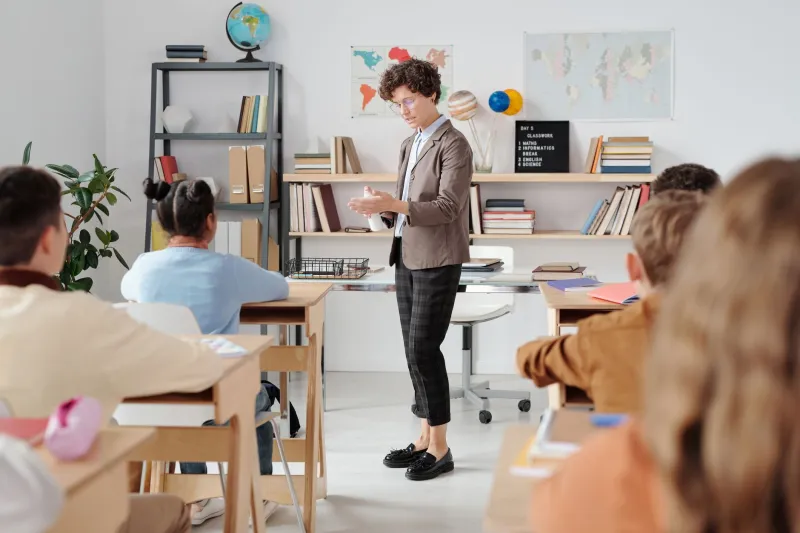
For most people, the memory of high school physics involves a lot of chalk dust, confusing diagrams, and the faint hope that the bell would ring early. Angular momentum? Sure, sounds important. Rotational inertia? Cool, whatever. But walk into certain classrooms across the country right now, and you might find students genuinely arguing — loudly, passionately — about the optimal water fill level for a half-liter bottle. Welcome to physics class in 2024.
Bottle flipping, the deceptively simple challenge that exploded into a full-blown cultural moment, has found an unlikely second life as a legitimate teaching tool. And the educators leading that charge aren't just tolerating the trend — they're building entire lesson plans around it.
"I Couldn't Get Them to Care About Torque — Until I Brought Out a Water Bottle"
Mr. Daniel Reyes teaches AP Physics at a high school outside of Columbus, Ohio. He'll be the first to tell you that his students were not exactly riveted by traditional rotational mechanics lessons. Textbook problems about spinning tops and rolling cylinders have their place, but engagement? That was always the battle.
"I'd been teaching for eleven years and I could see the exact moment I'd lose them," he said. "Then one day a kid was flipping a bottle in the back of my class, and instead of taking it away, I just... started talking about why it worked. The whole room locked in."
That impromptu detour turned into a full unit. Reyes now uses bottle flipping as the anchor for teaching angular momentum, center of mass, and the relationship between rotational force and landing stability. Students don't just flip — they measure, hypothesize, and run controlled experiments. How does changing the water level affect the bottle's rotation? At what point does the liquid's shifting center of gravity make a clean land impossible? Why does a faster spin sometimes hurt your chances of sticking it?
"The questions they ask now are the questions I used to have to drag out of them," Reyes said. "They care about the answers because they want to flip better."
The Science Behind the Stick
If you've ever wondered why some flips land clean while others wobble out immediately, the answer lives squarely in physics — specifically in the interplay between angular momentum and a shifting center of gravity.
When you flip a bottle, you're setting it into rotation. The water inside doesn't rotate with the bottle as one solid mass — it sloshes, redistributes, and acts as a kind of internal dampener. As the bottle reaches the top of its arc and begins to descend, the water rushes toward the bottom, lowering the center of gravity. That redistribution slows the rotation just enough for the bottle to settle into a vertical position on landing. It's not luck. It's fluid dynamics doing exactly what physics says it should.
The fill level matters enormously here. Too much water and the dampening effect is reduced — the bottle spins too fast and can't self-correct. Too little and there isn't enough mass shift to slow the rotation at all. The sweet spot — widely cited as somewhere between 25% and 35% capacity — gives the water enough room to move and enough mass to do the work.
For competitive flippers, understanding this isn't just academic. It's the difference between a 60% land rate and an 85% land rate.
Competitive Flippers Are Actually Studying Up
Ask the serious flippers in the community and a surprising number of them will tell you they've gone down the physics rabbit hole on purpose. Jake Morales, a 17-year-old from San Diego who competes in regional bottle flipping events, started watching YouTube explainers on rotational mechanics after he hit a plateau in his consistency.
"I kept landing at the same rate no matter how much I practiced," he said. "Then I started actually understanding why it works, and I could make adjustments that weren't just random. Like, I knew if I was spinning too fast, I needed less water, not more practice."
Jake isn't alone. Online forums and Discord servers dedicated to competitive flipping have entire threads where participants swap physics notes alongside trick shot videos. The community has essentially crowd-sourced a working understanding of applied mechanics — just framed around bottles instead of textbooks.
Schools Are Making It Official
Beyond individual teachers improvising lessons, some schools are getting more intentional about it. A handful of middle schools in states like Texas, California, and Washington have incorporated bottle flipping into formal STEM curriculum, using it as an entry point for broader physics and engineering concepts.
The appeal is obvious. It's cheap — a plastic water bottle costs nothing. It's immediately accessible — every kid already knows what bottle flipping is. And it creates a feedback loop that traditional experiments often lack: you flip, you see the result instantly, you adjust. That rapid iteration mirrors the scientific method in a way that feels real rather than procedural.
Ms. Priya Nkosi, a middle school science teacher in Austin, Texas, designed a six-week unit she calls "Flip Lab" that moves students from basic observation all the way through data collection and presentation. Students track variables, build graphs, and ultimately present their findings on what conditions produce the highest landing consistency.
"I've had kids who never turned in homework come in early to run more trials," she said. "That's not something I take lightly."
Where the Classroom and the Leaderboard Meet
What's genuinely cool about this crossover is that it flows both ways. Teachers are using the culture of flipping to make science stick. And flippers are using science to climb leaderboards. Neither group started out thinking they needed the other — but here we are.
For the competitive flipping community, having a deeper scientific vocabulary isn't just nerdy trivia. It's a legitimate edge. Flippers who understand why certain techniques work can communicate more clearly with each other, debug their form faster, and adapt to different bottle types and surfaces with intention rather than guesswork.
And for educators, the bottle flip is a rare kind of teaching gift — a phenomenon that students already have strong feelings about, that maps cleanly onto real physics concepts, and that produces results you can see with your own eyes in real time.
Reyes put it pretty simply: "I don't care if they remember my name in ten years. I care if they understand that physics isn't something that happens in a textbook. It happens every time you throw something in the air and wonder if it's going to land."
Hard to argue with that. Now go fill your bottle to 30% and get to work.